Written by: Xuan Jay Soo (PRP), 2 June 2026
Table of Contents
Quick Answer
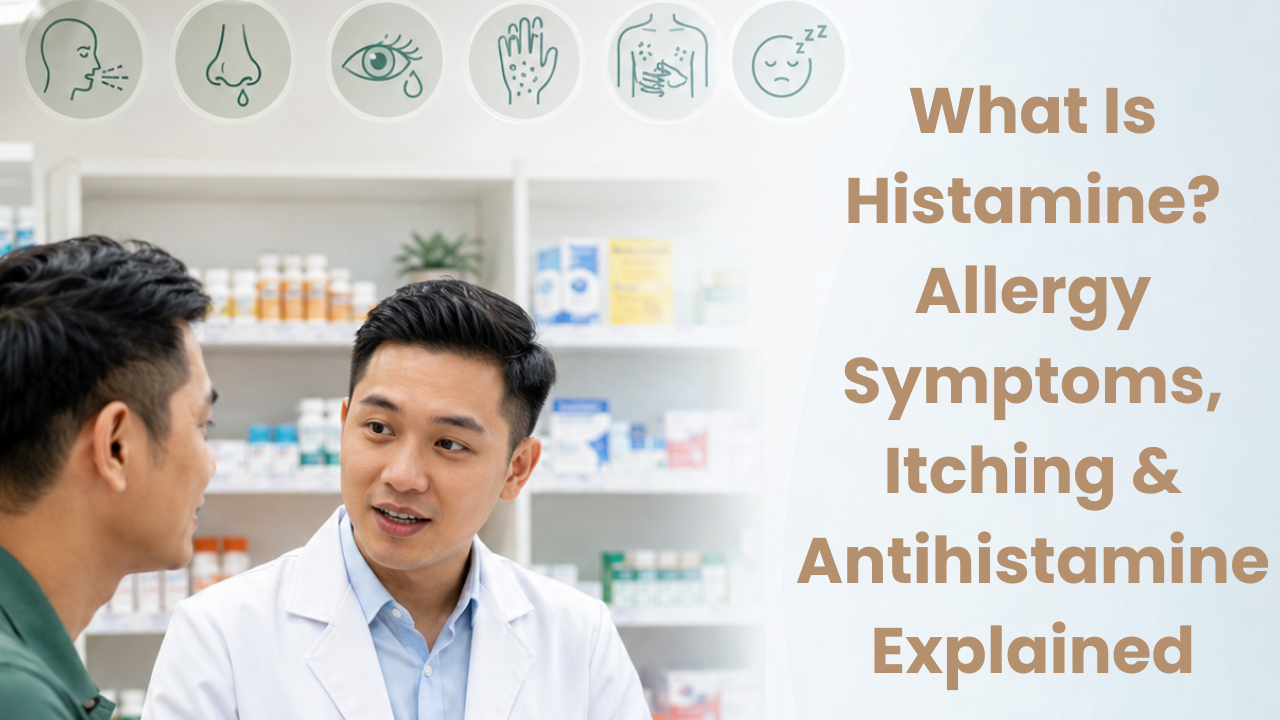
Histamine is a natural chemical messenger released by the body during certain immune reactions. It is best known for causing allergy-related symptoms such as sneezing, runny nose, itchy eyes, watery eyes, itchy skin, redness, swelling, and hives.
Histamine is not a “bad chemical”. It is part of the body’s normal defence system. It helps the body respond when it detects something it sees as a threat, such as pollen, dust mites, insect venom, certain foods, or other allergy triggers.
Antihistamines are medicines that reduce the effect of histamine. They may help with allergy-related symptoms, but they do not solve every itch, rash, blocked nose, eye problem, or swelling. If symptoms are severe, painful, widespread, or affecting breathing, medical advice is needed.
What Is Histamine?
Histamine is a chemical made naturally by the body. It is stored in immune cells such as mast cells, which can release it when the body detects an allergen or irritation.
In everyday language, histamine can be described as one of the body’s “allergy alarm chemicals”. When it is released, it sends signals that can lead to itching, redness, swelling, watery eyes, sneezing, and runny nose.
Many people first hear the word histamine through the word antihistamine. This makes sense because antihistamines are medicines designed to reduce histamine-related effects. However, histamine itself is not a medicine. It is a body chemical involved in immune response, inflammation, stomach acid signalling, and wakefulness.

This is why histamine affects people differently. In one person, histamine release may mainly cause sneezing and a clear runny nose. In another person, it may cause hives or itchy skin. In another, the main issue may be itchy, watery eyes.
What Does Histamine Do in the Body?
Histamine has several roles, but the most noticeable one for most people is its role in allergy symptoms.
When histamine affects the nose, it can cause sneezing, itchy nose, clear runny nose, and sometimes nasal blockage. When it affects the eyes, it can cause itchy, watery, irritated, or red eyes. When it affects the skin, it can cause itching, redness, swelling, or raised itchy patches known as hives.
Histamine can also make tiny blood vessels widen and become more “leaky”. This allows immune cells to move into the affected area. In some situations, this is useful because the body is trying to defend itself. In allergy, however, the body reacts too strongly to something that may not be dangerous to most people.
Histamine also helps support wakefulness in the brain. This is why some antihistamines that enter the brain can cause drowsiness. The drowsiness does not mean the medicine is always stronger; it often means the medicine is affecting brain alertness more.
Histamine also has a role in stomach acid signalling. This is why not all histamine-related medicines are used for allergies.
How Is Histamine Linked to Allergy Symptoms?
Allergy happens when the immune system reacts to a trigger that it sees as harmful. This trigger may be pollen, dust mites, pet dander, mould, insect stings, certain foods, or other allergens.
When the body reacts, immune cells may release histamine and other inflammatory chemicals. Histamine then contributes to common allergy symptoms such as sneezing, runny nose, itchy eyes, watery eyes, itchy skin, redness, and swelling.
This is why antihistamines can help some people. If histamine is a major driver of the symptom, blocking its effect may reduce the symptom.
However, histamine is only one part of many allergic reactions. It is not the only chemical involved. This is why antihistamines may reduce symptoms but may not fully control severe inflammation, swelling, heavy blocked nose, or complicated rashes.
For example, antihistamines may help runny nose and sneezing more than heavy nasal blockage. A blocked nose can involve swelling and inflammation beyond histamine alone.
This also explains why one antihistamine tablet does not solve every itch, rash, swelling, or eye problem. Eczema itch, fungal infection itch, scabies, widespread rash, painful skin, eye infection, or flu symptoms may not improve much with antihistamines alone. In these cases, the problem may need a different assessment.
Why Do Antihistamines Block Histamine?
Antihistamines work by reducing the effect of histamine at certain receptor sites in the body. For allergy symptoms, the most relevant group is usually H1 receptors.
Most allergy antihistamines work mainly on H1 receptors. These are involved in symptoms such as itching, sneezing, runny nose, watery eyes, and hives.
Histamine also acts on other receptors, such as H2 receptors in the stomach. This is why not all “histamine-related” medicines are used for allergies. Allergy antihistamines and stomach acid medicines may both relate to histamine, but they are not the same type of medicine.
There are older and newer types of antihistamines. Older antihistamines, often called first-generation antihistamines, are more likely to enter the brain and cause drowsiness. Newer antihistamines, often called second-generation antihistamines, are generally less sedating.
This does not mean drowsy antihistamines are always “stronger”. Drowsiness usually happens because the medicine affects the brain more, not necessarily because it treats allergy symptoms better.
Some patients think that if a medicine makes them sleepy, it must be more powerful. In reality, a sedating antihistamine may simply be less suitable for daytime use, driving, studying, work, caregiving, or elderly people at risk of falls.
Histamine, Allergy and Flu: What Is the Difference?
Histamine is linked with allergy reactions, but flu and common cold are usually caused by viruses.
This is why allergy and flu can be confusing. Both may involve runny nose, sneezing, throat irritation, or tiredness. However, allergy is an immune reaction to a trigger, while flu is an infection.
In allergy, symptoms may come and go with exposure to dust, pollen, pets, mould, weather changes, or certain environments. The mucus is often clear and watery, and itching is common.
In flu or viral infection, there may be fever, body aches, sore throat, cough, thick mucus, or feeling generally unwell. Antihistamines may reduce certain runny nose symptoms in some cold and flu products, but they do not treat the viral infection itself.
This is why it is useful to ask: “Is this allergy, flu, infection, irritation, or something else?”
Pharmacist’s Real-Life Perspective
In a pharmacy setting, many people ask directly for antihistamines by medicine name. They may ask for loratadine, cetirizine, fexofenadine, chlorpheniramine, or a familiar brand. This is common because antihistamines are widely known in Malaysia.
However, a pharmacist still needs to understand what the person is trying to treat.
If the person has sneezing, clear runny nose, itchy eyes, and watery eyes, histamine-related allergy is possible. If the person has widespread rash, painful skin, swelling, eye pain, vision changes, wheezing, or fever, the situation is different.
A pharmacist also checks whether the antihistamine is working as expected. If cetirizine makes someone drowsy, it may not be suitable before driving or work. If chlorpheniramine does not help someone sleep, that does not mean the dose should be increased. Chlorpheniramine is an antihistamine, not a proper sleeping tablet.
Using sedating antihistamines mainly to force sleep is not ideal without advice. Sleep problems may have other causes, and drowsiness can carry safety risks, especially for drivers, motorcycle riders, workers, caregivers, and elderly people.
Another common issue is when patients expect antihistamines to solve all itching. Antihistamines may help allergy-related itch, but itching from eczema, scabies, fungal infection, skin infection, liver problems, kidney problems, or severe inflammation may need a different approach.
If an antihistamine is not working, do not simply take extra doses unless advised by a healthcare professional. It may mean the symptom is not mainly driven by histamine, the trigger is still present, the condition is more severe, or another diagnosis is involved.
The pharmacist’s role is not only to choose a medicine. It is also to decide whether the symptom is still suitable for self-care.
When Should You Seek Medical Advice?
Seek medical advice if symptoms are severe, painful, widespread, worsening, or not improving.
A widespread rash, severe rash, blistering rash, peeling skin, rash with fever, or painful skin should not be treated as a simple allergy. Swelling that is getting worse also needs careful assessment.
Eye symptoms need extra caution. Itchy watery eyes may fit allergy, but eye pain, light sensitivity, vision changes, thick discharge, or marked redness should be checked.
Seek urgent help if there is wheezing, breathing difficulty, chest tightness, swelling of the lips, tongue, throat, face, or eyes, faintness, collapse, severe dizziness, or signs of anaphylaxis.
Children under 2 years old, pregnant or breastfeeding women, adults aged 65 years and above, and people with asthma, breathing problems, heart disease, liver disease, kidney disease, glaucoma, prostate problems, or regular medicine use should ask a pharmacist or doctor before using antihistamines.
Quick Summary
Histamine is a natural body chemical involved in allergy symptoms, immune response, stomach signalling, and wakefulness.
It can cause sneezing, runny nose, itchy eyes, watery eyes, itchy skin, redness, swelling, and hives when released during allergic reactions.
Antihistamines reduce histamine’s effects, but they are not suitable for every itch, rash, cold, eye problem, blocked nose, or swelling.
Older antihistamines are more likely to cause drowsiness because they can enter the brain more easily. Newer antihistamines are generally less sedating, but some people may still feel sleepy.
Seek medical advice for widespread rash, pain, eye symptoms, wheezing, breathing difficulty, severe swelling, or symptoms that are not improving.
FAQ
1. What is histamine?
Histamine is a natural chemical messenger in the body. It is involved in allergy symptoms, immune response, stomach acid signalling, and wakefulness.
2. Is histamine bad for the body?
No. Histamine is not bad by itself. It has useful roles, but it can cause uncomfortable symptoms when the body releases too much during an allergic reaction.
3. Why does histamine cause sneezing and runny nose?
Histamine can irritate the nasal lining and increase watery mucus production. This can lead to sneezing, itchy nose, and clear runny nose.
4. Why does histamine cause itchy eyes?
When histamine affects the eyes, it can cause itching, watering, redness, and irritation. This is common in allergic conjunctivitis.
5. Why does histamine cause itchy skin?
Histamine can stimulate nerves in the skin and contribute to redness, swelling, hives, and itching.
6. Why do antihistamines help allergies?
Antihistamines reduce the effect of histamine at certain receptors. This can help with symptoms such as sneezing, runny nose, itchy eyes, watery eyes, hives, and allergy-related itching.
7. Can antihistamines help a blocked nose?
They may help if the blocked nose is allergy-related, but antihistamines often help sneezing, itching, and runny nose more than heavy congestion. Persistent, painful, or one-sided sinus symptoms may need assessment.
8. Are drowsy antihistamines stronger?
Not necessarily. Drowsiness does not always mean stronger allergy relief. It often means the medicine is affecting the brain more and may be less suitable for daytime use.
9. Why is my antihistamine not working?
It may be because the symptom is not mainly caused by histamine, the allergen trigger is still present, the condition is more severe, or another problem such as eczema, scabies, infection, or flu is involved.
10. When should I ask a pharmacist or doctor?
Ask for advice if antihistamines make you drowsy, symptoms keep returning, symptoms are severe or painful, there is widespread rash, eye pain, wheezing, breathing difficulty, or if the person is under 2 years old, pregnant, breastfeeding, elderly, or taking regular medicines.